

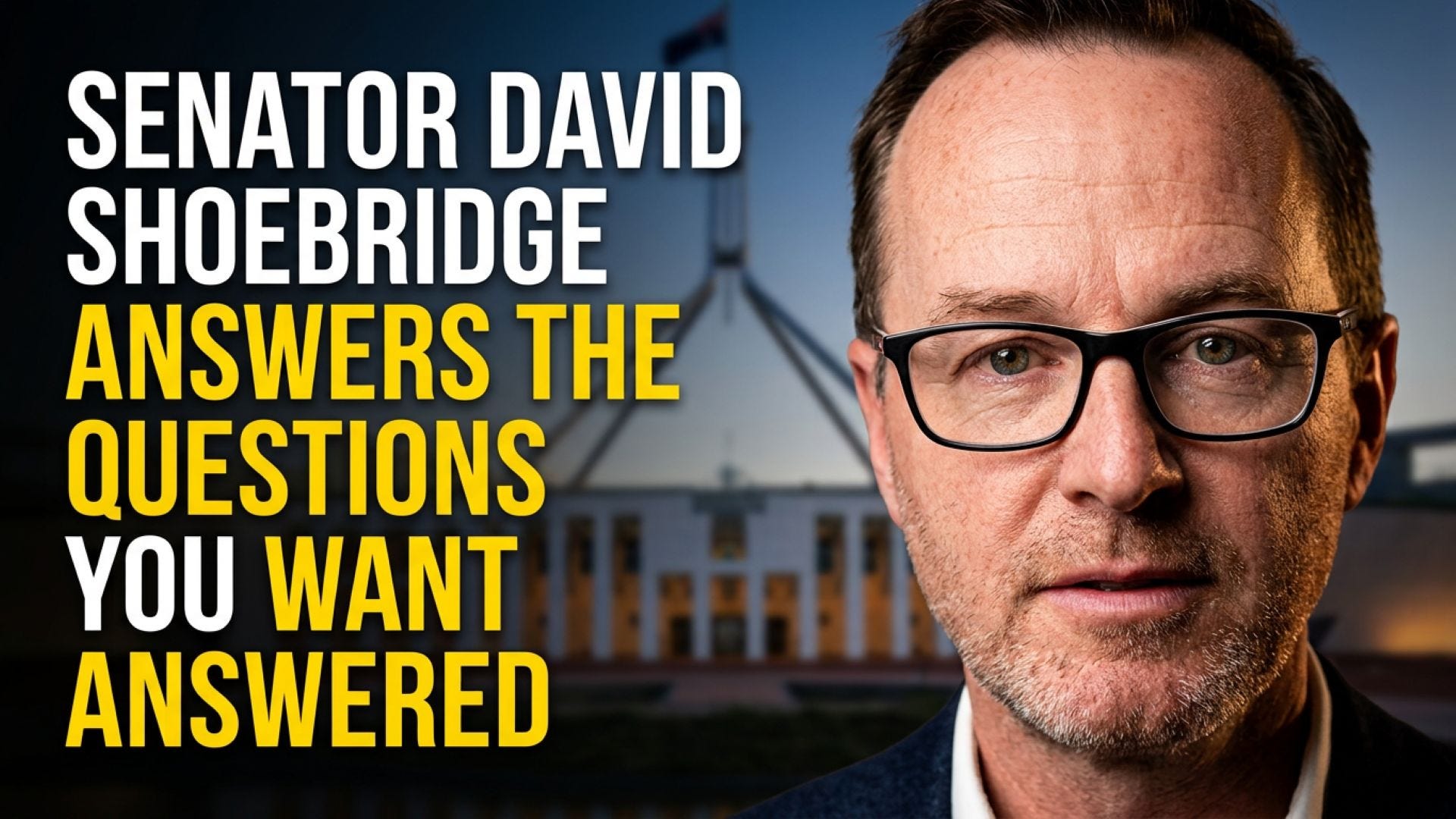
Large-scale public housing construction could ease Australia’s housing crisis if the federal government were willing to fund it and challenge property interests, Senator David Shoebridge told Australia Asks. Responding to a question about European housing models and mass production, the NSW Greens senator pointed to Australia’s postwar building programmes and overseas examples including Vienna and Singapore.
He supported modern construction methods combined with energy-efficient design, renewable power and water conservation. Shoebridge argued that additional revenue from gas exporters could help pay for the programme, citing a Greens proposal he said could raise about $17 billion a year.
Asked what the Greens meant by wealthy people paying a fair share, Shoebridge outlined a specific tax on very large fortunes. Under the proposal he described, net wealth between $100 million and $1 billion would attract a 5 per cent tax, with wealth above $1 billion taxed at 10 per cent.
He argued that the existing system placed too much weight on earnings from work while allowing enormous fortunes to grow without equivalent taxation of that growth. Shifting the balance towards wealth taxation, he said, was necessary to fund services, reduce inequality and sustain confidence in the political system.
A question about migration and businesses’ incentives to improve wages and training prompted him to challenge the economic framing of immigration. Shoebridge argued that successive governments had increasingly treated migrants as labour-market inputs while reducing the emphasis on family reunion.
He wanted policy to recognise whole lives, including grandparents’ contributions to childcare, language and culture. He also challenged the claim that migration alone explained housing unaffordability, pointing to rising property prices during the pandemic border closures. A successful migration system, he said, should build connected communities as well as meet economic needs.
On countering rhetoric directed at migrants and minorities, Shoebridge urged people to bring the discussion back to individuals and their lives. He suggested talking about familiar neighbours, nurses, shopkeepers and relatives, rather than accepting a debate that reduced migrants to abstract economic costs.
Those people were not responsible for cabinet decisions on housing, education or investment, he argued. He accused powerful interests of benefiting when public anger was directed towards migrants instead of wealth and corporate influence, and said a more effective response required solidarity around shared interests.
Asked whether the Greens could become a credible alternative in regional seats drifting towards One Nation, Shoebridge acknowledged that many would not turn Green quickly. He nevertheless pointed to established support in the NSW Northern Rivers and said the party wanted strong candidates across the country.
His proposed regional pitch centred on public education, hospitals, banking, insurance and other services. He argued that regional communities had much to lose from privatisation and weaker workplace protections, and said the Greens needed to overcome preconceptions by listening and meeting voters where they were.
The broader challenge was making detailed policy connect emotionally. Asked how the Greens could counter populism and One Nation’s appeal, Shoebridge conceded that his party could be absorbed in policy detail while voters responded to identity and instinct.
He maintained that comprehensive proposals remained essential, but said the Greens had to make their benefits feel immediate and personal. Taxing billionaires, funding public education and reducing student debt could form a popular political offer, he argued. He also contended that corporate backing and extensive media attention gave One Nation an advantage in getting its message heard.
A separate question asked why disillusionment with the major parties was not producing a larger lift in Greens support. Shoebridge said he wanted the party to examine that failure directly rather than be satisfied with a relatively stable vote. He described more contact with communities and stronger campaigning as essential to building support.
His ambition extended beyond holding the balance of power: he wanted the Greens to replace established parties. Building that strength without becoming dependent on the corporate interests he criticised would be difficult, he said, but fundamental to the project.
On vested interests, Shoebridge identified donations and internal policy-making as key differences between the Greens and their opponents. He said the party operated an ethical donations framework, relied overwhelmingly on individual contributions and developed policies through its members.
He contrasted that with what he described as the influence of corporate donors and lucrative jobs after politics elsewhere in the system. Gambling reform was one example he offered of the policy consequences: he argued that independence from the industry helped the Greens advocate stronger protections for the public.
Asked whether his attacks on Anthony Albanese reflected personal animosity, Shoebridge denied a personal grievance and described frustration with what he regarded as a squandered opportunity. He argued that Labor’s parliamentary strength, together with potential Greens support in the Senate, created room for substantial progressive reform.
Instead, he said, people continued struggling with rent, bills and uncertainty while governments directed resources towards corporate subsidies and defence spending he opposed. His challenge was to turn that anger into constructive organising rather than allow it to become destructive.
Foreign investment raised questions about where national-interest limits should apply. Shoebridge defended scrutiny of American companies as well as those from China or Russia, focusing on data company Palantir. He argued that its stated political agenda, government relationships and involvement in sensitive data made its Australian contracts inappropriate.
He also raised concerns about US powers to obtain data held by American companies. Rather than treating the United States as exempt from scrutiny because it was an ally, he wanted consistent assessment of foreign corporate influence, including in private-sector partnerships.
Digital privacy prompted a defence of the Greens’ opposition to the under-16 social media ban. Shoebridge argued that excluding children from platforms failed to address harmful algorithms and could push young users towards less protected online spaces. His preferred approach was to impose stronger safety obligations on platforms for everyone.
He also advocated modern privacy laws limiting tracking and data harvesting, protecting children’s information and requiring meaningful consent. Responding to the suggestion that the Greens supported the ban, he said their position had received insufficient attention, and renewed his call to remove Palantir from Commonwealth contracts.
On cannabis, Shoebridge acknowledged addiction and other harms but argued that prohibition made regulation less effective. Leaving an illicit market to organised crime provided poor safeguards for product quality, strength and health information, he said. A legal market could establish testing, standards and advice while reducing criminal profits.
He also argued that criminalisation inflicted its own damage through convictions, employment and travel consequences, with policing falling disproportionately on communities with less political power. Adults should be able to make informed choices, he said, while government worked to minimise harm.
Asked about Queensland drug-driving laws and their comparison with NSW, Shoebridge criticised what he described as a broader Australian reliance on detecting cannabis rather than proving impairment. He said losing a licence could also mean losing work, particularly in regional areas, and recounted patients’ accounts of being forced to choose between prescribed cannabis and driving.
His proposed alternative was assessment of impairment across drugs, whether prescribed or illegal. He stressed that impaired drivers should not be behind the wheel, while arguing that mere presence offences confused drug prohibition with road safety.
A lighter question asked how Shoebridge had joined the Greens without a hyphenated surname. He joked that the two nouns already contained in his name might explain his admission, and said the party had to make room for some non-hyphenated Australians.
The exchange prompted a reflection on conversations with his wife about combining family names when they had children, and how parents might acknowledge both sides of a family without endlessly adding hyphens across generations.
His musical preferences had changed over time. As a teenager, Shoebridge had been absorbed by the Doors, followed in his early twenties by Sydney band Ratcat. He no longer identified one group as dominating his listening, but expressed particular affection for Australian performers. Alex the Astronaut stood out for a distinctive voice he found engaging and charming.
Required to choose a favourite song, Shoebridge returned to the Doors and nominated Riders on the Storm. He described the opening storm sounds, repeating musical pattern and haunting atmosphere as central to its appeal.
Science fiction shaped his film preferences. Shoebridge said he valued the genre’s ability to offer a different lens on the world, naming Project Hail Mary as a recent favourite that had moved him to tears. He had also read and admired the book. Alien was another film he singled out from a much longer list of science-fiction possibilities.
For television, Shoebridge nominated The Good Doctor, saying he had been drawn into its storyline. The hospital setting also prompted an admission that seeing blood and organs was not his strength. That, he joked, helped explain why he had become a lawyer rather than a doctor.
For a favourite meal out, Shoebridge chose a Chinese noodle restaurant in Sydney’s Chinatown, praising its sticky eggplant, dumplings and noodles. He said the combination was difficult to pass up.
Asked about his greatest role models, Shoebridge chose two people from different stages of his career. An early supervising solicitor, David Coleman, had taught him to be authentic rather than imitate clients’ mannerisms in an attempt to connect with them.
Clients wanted a capable lawyer who was himself, he recalled. His other example was former NSW Greens colleague John Kaye, whose principles and commitment to social justice had shaped him through their years working together in state parliament.
You can see the full interview with Senator David Shoebridge on the Pub Politics Video Podcast at:
The questions were sourced from the general public through an online Q&A on the Australian community of Reddit (AMA): https://www.reddit.com/r/australian/comments/1uyin7d/ama_im_david_shoebridge_greens_senator_for_nsw/