

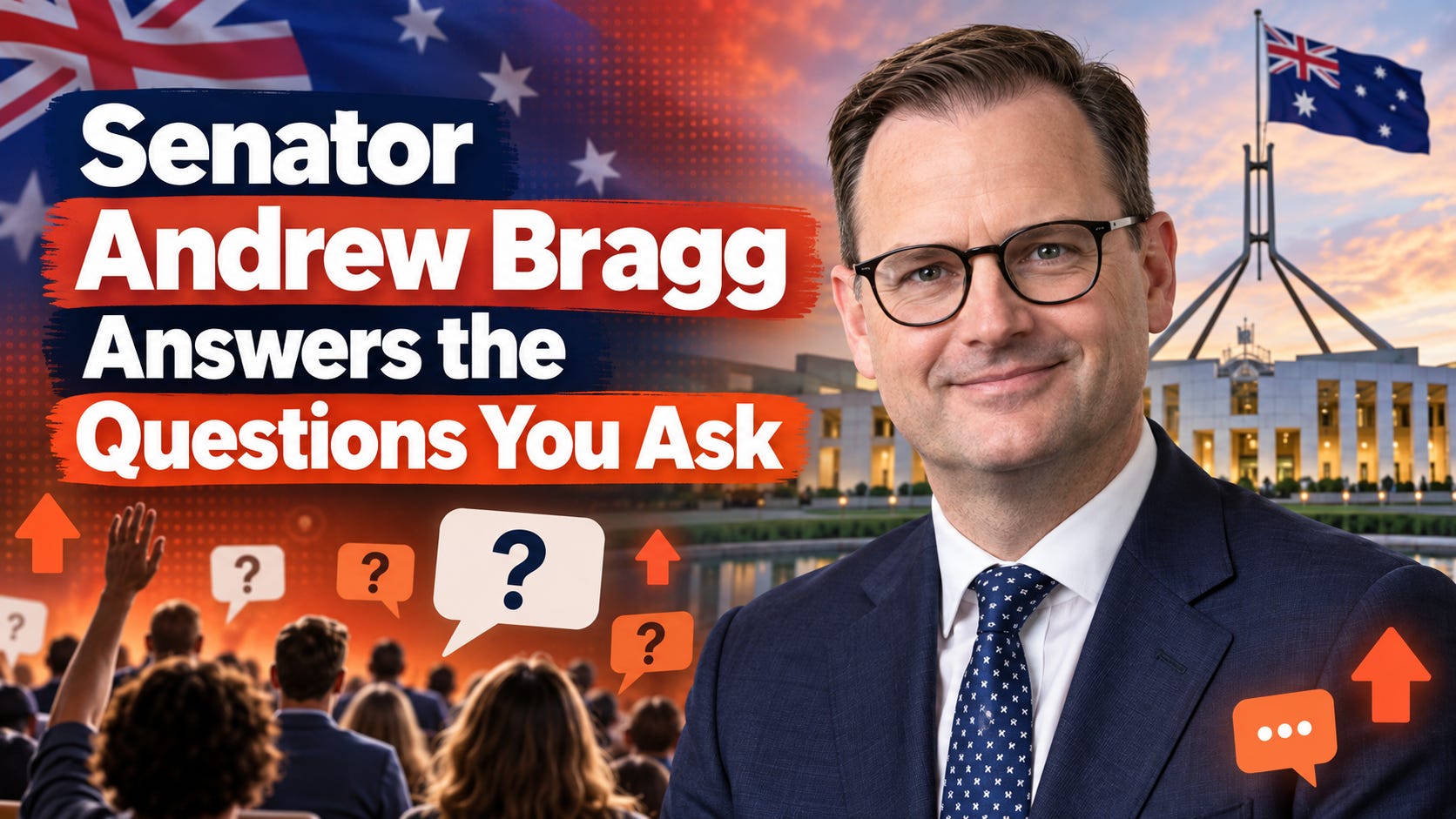
Liberal senator Andrew Bragg made the case for increasing housing supply, reducing migration-driven demand and targeting assistance to buyers in a Reddit Ask Me Anything. Asked what should happen to median house prices over the next three to six years, the NSW senator declined to set a price target. He said the aim was greater affordability and proposed means testing the government’s 5 per cent deposit scheme alongside measures to get more homes built.
Asked how people receiving Centrelink payments could afford rising rents, Bragg again pointed to supply. His proposed response was to get more houses built at lower cost, arguing that additional homes would bring rents down. He offered no separate proposal for income support or rental assistance in that reply.
On whether landowners should be able to build more housing on their land, Bragg said barriers should be removed and that the Coalition was examining the issue. He gave no detail about which limits would change or how far landowners’ development rights would extend.
A reader asked whether reducing the National Construction Code would compromise safety. Bragg said safety standards would be maintained and singled out disability access and energy efficiency rules as expensive components. His written answer stopped short of explaining what he would do with those requirements, leaving their proposed treatment unclear.
Another reader challenged the suggestion that weaker building standards would improve affordability, arguing that households could face higher utility bills. Bragg responded by pointing to requirements unrelated to energy efficiency, including reinforced walls, wider corridors and ramps, which he described as expensive additions.
A longer question listed construction requirements covering cyclone resistance, waterproofing, fire safety, natural light, ventilation and accessibility, and asked which protections Bragg regarded as unnecessary. He said he did not expect agreement and described the reader’s position as support for leaving the existing “very heavy rulebook” in place. He did not identify particular provisions to remove.
Asked why regulation was assumed to improve outcomes, in a question proposing cheaper commercial-style construction for homes, Bragg argued that people had been conditioned to expect more rules to help. He said excessive regulation damaged the economy, without specifically endorsing the construction method the reader suggested.
A separate reader challenged how tax cuts and deregulation could be reconciled with public services, building quality and the expense of reviewing the construction code. Bragg said the existing combination of high taxes and extensive regulation was failing. He argued that returning to liberal principles and encouraging enterprise offered a way out of the housing crisis, leaving the questions about funding and safeguards unanswered.
Asked whether removing GST from new homes could encourage construction and reduce costs, Bragg said a rebate would be difficult and probably impossible to deliver. He said other ways to reduce taxes on new housing were being considered but did not specify them.
On a return to government-led housing construction, Bragg said public housing had a role and suggested the Commonwealth could help state governments provide it. He said direct federal delivery would not necessarily be the preferred approach. The same question asked whether tenants who damaged properties or behaved antisocially should be excluded, a point his answer did not address.
Asked about existing homes being used for Airbnb and other short stays instead of permanent accommodation, Bragg said regulation was a state responsibility. He said he tried to concentrate on federal matters.
On migration, a reader proposed reducing reliance on pathways from international study to permanent residency and placing greater emphasis on highly skilled applicants. Bragg said that approach was under consideration, offering no further detail.
Asked why governments allowed Australian companies to move jobs offshore, Bragg said those decisions were for the companies concerned. He argued that lower taxes and less regulation would improve Australia’s competitiveness and help support local jobs.
A reader asked whether the Liberal Party was considering new sources of revenue and proposed a legal cannabis market. Bragg pointed instead to his National Press Club speech, where he said he had raised the prospect of seeking more revenue from large technology companies. He did not state a position on cannabis legalisation.
Asked what he thought was wrong with superannuation, Bragg said the system failed to deliver adequately for either individuals or the budget. He argued that banks and unions benefited from fees and control over retirement savings. His short answer offered no specific reform or supporting figures.
On why neither major party had resolved longstanding housing problems, Bragg blamed powerful vested interests and an unwillingness in Canberra to take risks. He said those interests had substantial influence over public debate and made reform harder.
Asked why he had not pursued his current proposals during the Coalition’s time in government, Bragg replied that he had never been a minister. He provided no further explanation in that exchange.
Another reader combined a similar challenge about reform in opposition with a question about his judgment on the banking royal commission. Bragg responded, “It’s hard to make perfect judgements all the time but I do my best.” He did not separately address either part of the question.
Asked whether the Liberals had considered governing beyond election cycles, Bragg answered yes. He did not elaborate on what that would involve.
A reader questioned whether the Coalition had constructive policy proposals while it was focusing public criticism on a controversy involving melons. Bragg responded with a link to a Senate inquiry’s interim report and said it contained 20 recommendations aimed at improving housing productivity.
Asked why he had appeared on property industry figure Jack Henderson’s podcast, Bragg said he was willing to engage broadly. Appearing on a program, he said, did not mean he endorsed its host’s views or policies.
The questions were sourced from the general public through an online Q&A on the Australian community of Reddit (AMA): https://www.reddit.com/r/australian/comments/1vm48tp/i_am_senator_andrew_bragg_ask_me_anything/