

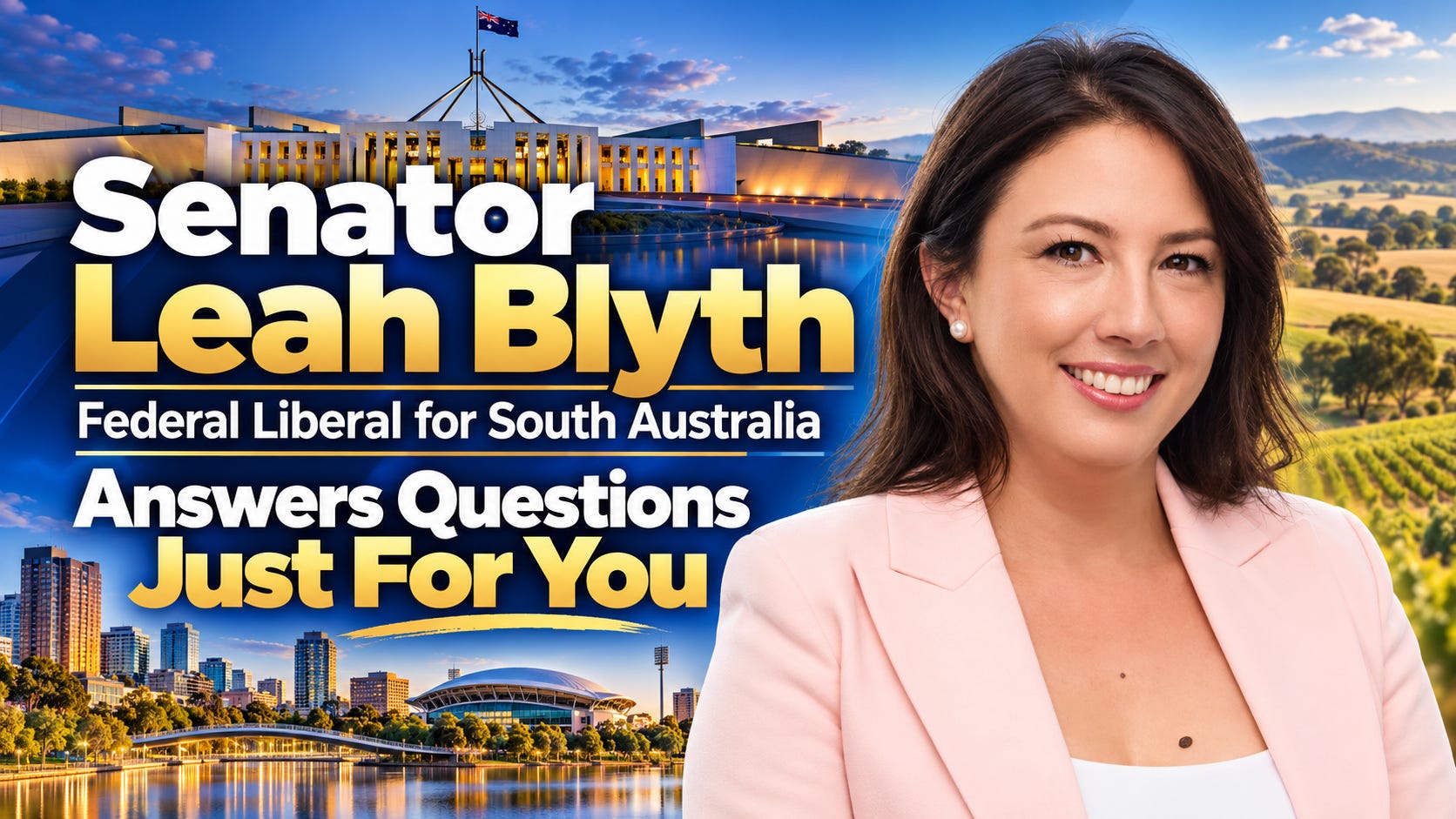
Stronger families and communities require greater parental choice, lower taxes and less government interference, Senator Leah Blyth argued during an October 2025 Reddit Ask Me Anything discussion. The South Australian senator, participating as a Liberal, identified living costs, housing shortages, regional health access and natural disasters as pressures on families.
Asked about the obstacles to stronger communities, she called for tax reform, fewer regulatory barriers and an education system that respected families’ values, arguing that weakening family and community ties damaged social cohesion.
Her emphasis on individual responsibility extended to a question about whether single people were disadvantaged by the tax system. Blyth responded that Australians generally were poorly served by existing arrangements and needed comprehensive reform that encouraged investment, work and saving.
She accepted that higher earners should pay proportionately more, but argued that the system should avoid penalising effort or rewarding people who could contribute but chose not to. She did not propose a specific measure addressing the reader’s concern about single taxpayers.
Challenged over inequality and whether large corporate profits should face greater taxation, Blyth rejected the premise that free-market policies were responsible for Australia’s economic difficulties. She credited democratic capitalism with historic improvements in prosperity and argued that extensive intervention and attempts to impose equality could harm poorer people.
Governments should improve opportunities for people to advance, she said, while wealth earned by providing products or services that others wanted should be celebrated rather than punished. Her answer did not outline a resource-tax proposal.
Housing affordability was another area where she placed responsibility on government settings. Blyth argued that planning restrictions and industrial relations laws contributed to the crisis, including by drawing builders and tradespeople towards lucrative public infrastructure work instead of private housing.
She also criticised approval delays. Although she acknowledged that housing shortages had multiple causes, her proposed response centred on changing planning and workplace rules so the market could deliver more affordable homes.
Asked about small businesses’ access to finance, particularly difficulties faced by self-employed people as housing became less affordable, Blyth favoured greater competition among financial institutions and minimal government intervention.
If a bank was willing to lend to a business, she argued, government should not unnecessarily prevent it. She advocated light regulation of financial and equity markets, expressing greater confidence in market decisions than in those of Canberra officials.
Childcare brought a more direct challenge to her stated support for families. Asked why she had opposed the Early Childhood Education and Care (Three Day Guarantee) Bill 2025, Blyth emphasised the Coalition’s commitment to allowing families to choose arrangements suited to their circumstances.
She pointed to shift workers and families relying on relatives as examples of people whose needs could differ from conventional childcare models. Her response stressed flexibility and choice without directly explaining why those objectives required opposition to the bill.
In a separate question linking her education background, school funding and childcare costs, Blyth concentrated on the economics of childcare. She argued that regulation increased providers’ costs while growing subsidies stimulated demand and pushed prices higher.
Continually expanding subsidies were unsustainable, she said, proposing that other approaches, including tax breaks for families, should be considered. She linked that preference to her reasons for joining the Liberal Party, but did not directly address the reader’s concerns about public school funding.
Her answer on practical life skills returned to a division of responsibility between schools and families. Drawing on her career in education before politics, Blyth expressed frustration with the system and called for a return to fundamentals.
Schools should concentrate on teaching knowledge, she argued, while families and communities should teach values. She did not set out a particular curriculum for budgeting, correspondence or critical thinking, the examples raised by the reader.
Asked explicitly whether climate change was real and primarily caused by human activity, Blyth said she accepted that the climate was changing and that humans appeared to have an influence, potentially a significant one. She did not explicitly endorse the question’s formulation that human activity was the primary cause.
Instead, she described the extent of that influence and the policy response as matters for debate. She opposed Australia’s climate policy settings, arguing that their economic costs were unjustified and alleging that other countries were retreating from commitments while major emitters did too little.
A related question asked whether the Liberals could regain affluent metropolitan seats such as Curtin without a clearer position on decarbonisation, and whether generational change was needed. Blyth rejected tailoring national policy to particular electorates. The party should develop policies for the whole country and argue for them convincingly, she said, rather than attempt to appeal differently to different groups. She did not directly address the proposed change in political generations.
On defence, Blyth gave an unequivocal endorsement of increased spending when asked about military capability, particularly the navy. She said successive reports, including work commissioned under Labor, had warned that the existing budget was insufficient for Australia’s defence needs. She strongly criticised the government’s approach and described protecting the public as its first duty, although she did not nominate a spending target or particular naval acquisitions.
Foreign investment prompted a more qualified position. Responding to concerns about overseas ownership of telecommunications infrastructure following an Optus outage, Blyth argued that Australia’s living standards and infrastructure depended on foreign capital because the domestic economic base was too small to fund everything required.
She supported safeguards for critical infrastructure, while warning that regulation could create unintended problems. She did not attribute the outage to foreign ownership or commit to a specific parliamentary intervention.
A question from a transgender Australian challenged Blyth’s public positions on inclusion and representation. Blyth framed the issue as a potential conflict between transgender rights and women’s rights, saying she would prioritise what she regarded as women’s safety and fairness in settings including sport, prisons, schools and toilets.
She said transgender people deserved dignity and respect, while defending restrictions where she believed competing rights conflicted. She did not directly compare her views with those of the overseas figures named by the reader.
Asked whether colleagues were importing American-style culture wars, Blyth defended the Coalition’s ability to address social controversies alongside practical concerns. She argued that cost of living, immigration, health, defence and education should remain central, while maintaining that the party should challenge policies it considered harmful to families and women.
Her reply rejected the suggestion that engaging in those disputes necessarily displaced attention from everyday pressures.
Explaining why she had joined the Liberal Party, Blyth cited its support for individuals and families, smaller government and lower taxation. She acknowledged that the party did not always live up to its principles, but said she believed those principles produced stronger living standards and more cohesive communities. Her stated ambition was to help return the party to those foundations.
In another response, Blyth identified lower taxes, individual freedom and less government interference as potential common ground with Australians. She again acknowledged the gap between Liberal ideals and the party’s performance, while arguing that its underlying philosophy could attract broad support.
Addressing electoral rejection in a separate reply, Blyth argued that disillusionment affected both major parties rather than the Liberals alone. She said the party had failed to distinguish its policy positions clearly enough from Labor’s and needed to make a stronger case for smaller government, lower taxes and greater freedom. That did not mean opposing every government initiative, she said, but required a more recognisable alternative.
Asked to nominate a change to Australia’s electoral system, Blyth instead proposed reducing the number of tiers of government from three to two to streamline administration and cut bureaucracy.
She acknowledged that such a change would be extremely difficult constitutionally. More broadly, she praised Australia’s democratic stability and prosperity and urged caution when changing its constitutional arrangements, without identifying which level of government she would remove.
Public expenditure brought scrutiny closer to home. A reader questioned her reported spending of more than $100,000 over three months to July, including more than $30,000 on printing. Blyth replied that her total expenditure ranked 19th among 21 South Australian parliamentarians for the period and included the initial establishment of her electorate office.
She said she was conscious of the value of taxpayer funds, but did not separately explain the printing expenditure.
Looking twenty years ahead, Blyth said Australia’s prospects depended on decisions about innovation, regulation and investment in defence, energy and education. She envisaged the possibility of a technologically advanced, secure country with energy independence and strong food and critical-minerals industries, while warning of the alternative of greater debt, bureaucracy and social fragmentation.
Despite those concerns, she expressed optimism, placing her confidence in individual enterprise, self-reliance and a government that understood its limits.
The questions were sourced from the general public through an online Q&A on the Australian community of Reddit (AMA): https://www.reddit.com/r/australian/comments/1ocwm7r/im_leah_blyth_a_south_australian_liberal_senator/