

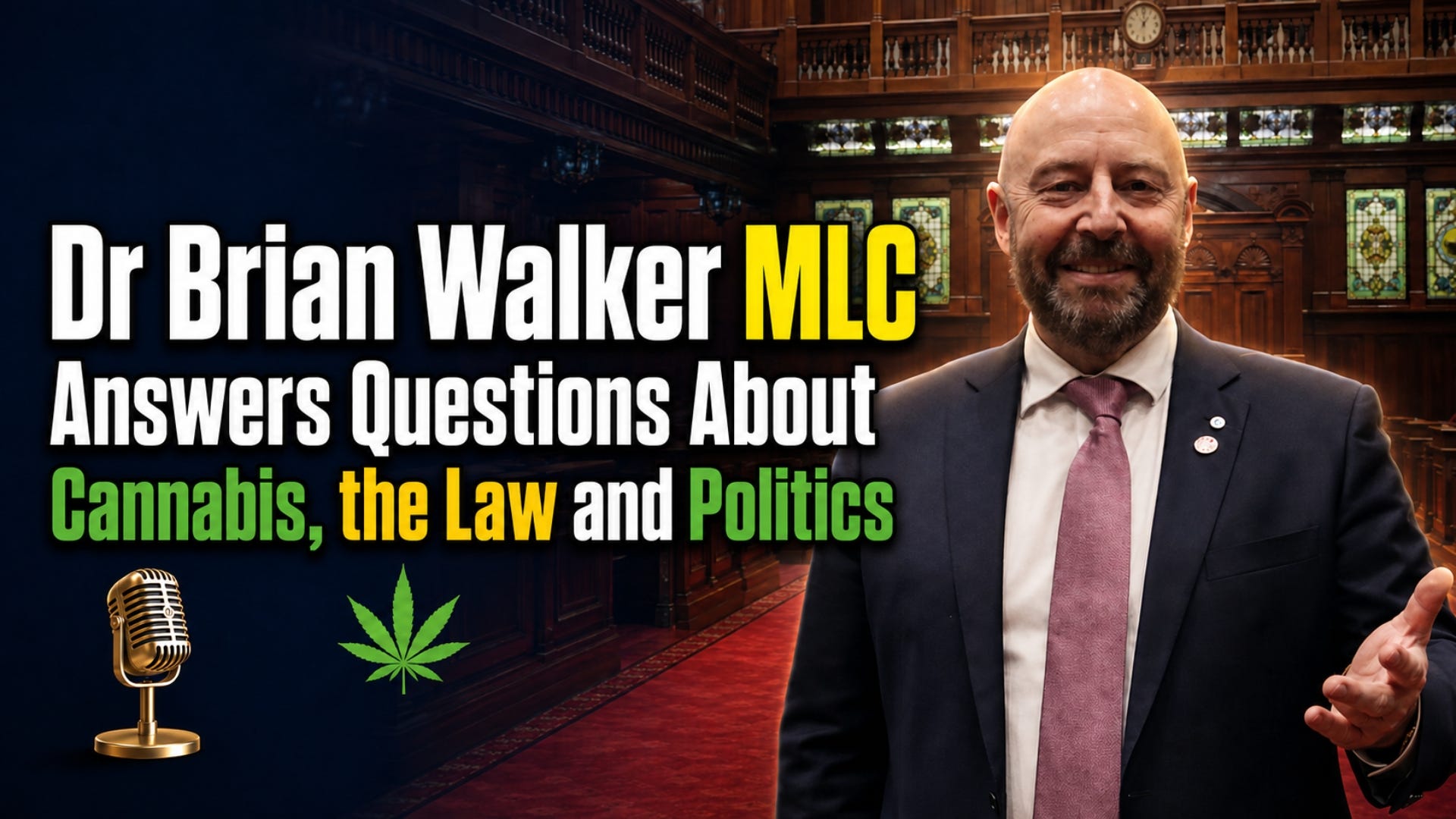
Dr Brian Walker says Western Australia’s medicinal cannabis patients are still waiting for clarity on proposed changes to drug-driving laws, despite a lengthy government review. Speaking on Australia Asks, the Legalise Cannabis member of WA’s Legislative Council accused the government of delaying reform and withholding the findings of its working group on THC and driving.
Asked whether the working group’s findings had led to progress, Walker said his understanding was that a report had been completed and legislation drafted, but further ministerial approval was needed before the proposal could reach cabinet. He said the report had not been shared with him and he could not describe what the proposed legislation contained.
For Walker, the dispute was about the treatment of patients who could lose their licence after testing positive for THC even when they considered themselves unimpaired. He said the public had paid for the review and deserved access to its conclusions. His account left the timing and contents of any bill unresolved.
Asked what legalisation should look like, Walker proposed allowing adults to grow cannabis at home, drawing a comparison with people growing grapes or brewing their own beer. He expected many consumers would still choose commercially produced products for convenience and consistent quality.
He also supported regulation to protect children and consumers. A reader had raised contamination risks and the cost of complying with production standards. Walker’s answer focused on making access lawful while retaining safeguards, rather than setting out a detailed testing or licensing framework.
Walker criticised existing prescribing restrictions in Western Australia, arguing that excessive barriers could limit patients’ choices. He wanted rules developed by people willing to consider cannabis’s potential benefits and risks, and said a legal market could reduce the role of criminal suppliers.
A second question asked how legalisation could avoid concentrating the market in the hands of a few large companies. Walker warned against handing control of the industry to major businesses and said individuals should retain meaningful choices about growing and using the plant.
He compared cannabis use with alcohol consumption, arguing that the way a person used a substance mattered. Where use became harmful, he favoured access to medical support. His answer expressed concern about corporate dominance without proposing specific market-share limits, ownership rules or protections for smaller producers.
A veteran offered a testimonial about relief from Department of Veterans’ Affairs-funded cannabis and thanked Walker for his advocacy. Walker responded by recalling his own service in Britain’s Territorial Army and the military service of several generations of his family.
Walker said he also treated veterans and welcomed DVA’s willingness to support some medicinal cannabis treatment. He criticised what he described as restrictive approval and product rules, while acknowledging support for other treatments, including psychedelic-assisted therapies.
He said veterans needed more sustained attention to physical and mental suffering beyond ceremonial recognition. Drawing on his experience with patients, he argued that cannabis could have a role in treatment and harm reduction, while stressing that it was not a remedy for every condition.
Asked whether his political interests extended beyond cannabis, Walker said his medical background shaped how he approached almost every bill. He assessed proposals through their effect on physical, mental, social and financial wellbeing, whether the subject was transport, taxation or public services.
He listed living costs, education, health and policing among his interests. On hospitals, he argued that ambulance ramping was a symptom of deeper problems in the health system and that debate should address those underlying pressures.
Walker also put accountability at the centre of his politics. He said truth, freedom and justice should guide public decision-making and argued that governments too often managed perceptions instead of confronting problems. He presented the cannabis campaign as part of that broader challenge to official assumptions.
Asked what laws his party would use to address inequality, corporate influence and foreign interests, Walker focused on the difficulty of changing institutions. He said a small crossbench party had limited power and would need substantially more elected representatives to drive major changes.
Even winning government would leave reformers dealing with established systems and administrative inertia, he argued. He favoured incremental change and a wider public discussion about what government should deliver and how citizens could influence it.
His reply raised possible ways of increasing participation, including new voting technologies, but did not specify tax, corporate or foreign policy legislation. He urged people to take a more active role in deciding how they were governed.
On his call to abolish question time, Walker said the purpose of questioning ministers was to obtain information and hold the government to account. He argued that evasive replies and partisan performance too often frustrated that purpose.
Walker acknowledged that some ministers tried to answer properly and said the upper house was generally more restrained than the lower house. He remained dissatisfied with how much useful information the process produced.
Asked what should replace question time, he said he did not yet have an answer. He wanted Parliament to examine how members could obtain the information needed to test ministers’ claims and scrutinise government decisions.
A voter in the Secret Harbour by-election asked whether supporting the Legalise Cannabis candidate would send their preferences to Labor. Walker said voters should decide their own preferences and that the party was not recommending support for another party in that contest.
He linked that position to frustration with Labor over the pace of medicinal cannabis driving reform. Walker said promises had failed to produce the action his party expected and described the delays as a reason for withholding a preference recommendation.
He also argued for a broader debate about democratic participation, referring to ideas associated with Switzerland’s cantonal system. He wanted citizens to have a greater voice between elections, though he did not set out a finished electoral reform model.
Asked how he had adapted to Parliament without previous political experience, Walker admitted he enjoyed the role more than he had expected. He had entered with a bleak view of politicians and was surprised to find colleagues he liked personally, including people who strongly disagreed with him.
His criticism remained directed at party structures and a system he believed favoured established interests. Walker said Parliament’s unfamiliar rules took time to learn and that new members needed to work out how to operate within them.
Asked how new One Nation members might adjust, he anticipated internal disagreements and a period of learning. He said leadership would matter in helping newcomers work together and argued that representatives across parties should question whether existing arrangements served their communities.
Away from politics, Walker named Runrig as his favourite band. He praised the combination of Gaelic language, rock music and lyrics that he found moving.
He spoke about the music with evident affection, saying its words were a large part of its appeal. Although the band was no longer making new music, it remained his first choice.
Asked separately for a favourite song, Walker returned to Runrig and chose An Ubhal as Airde, also known as The Highest Apple.
He had already singled it out while discussing the band, describing it as one of his favourite songs. The follow-up question confirmed the choice.
On films, Walker said he had several favourites and named Love Actually as one he particularly enjoyed.
He said Zulu had made a lasting impression on him. Having been a singer himself, he remembered the soldiers’ singing as part of what drew him to the film.
Asked about television, Walker said he did not generally watch it.
If he did sit down to a series, he would choose something such as Midsomer Murders. He described the preference as old-fashioned.
Given a choice between Star Wars and Star Trek, Walker said he liked both but preferred Star Trek.
He recalled seeing the kiss between Captain Kirk and Lieutenant Uhura on television, without appreciating its significance at the time. He said the series appealed to him for its treatment of moral questions and possible solutions.
Asked about his role models, Walker named his father, who died when Walker was 17. He said the loss remained deeply felt and that his father had helped make him the person he became.
In politics, he chose Nelson Mandela. Walker admired Mandela’s ability to overcome his circumstances and provide moral leadership.
A final question asked what lessons those role models had taught him. Walker shifted the discussion towards his interest in science, particularly ideas he associated with quantum physics and the nature of human existence.
He said that interest had changed how he looked at life and its problems. He did not develop the connection in detail, ending the interview on a personal reflection about the perspective he brought to public life.
You can see the full interview with Dr Brian Walker MLC on the Pub Politics Video Podcast at:
The questions were sourced from the general public through an online Q&A on the Australian community of Reddit (AMA): https://www.reddit.com/r/australian/comments/1vfusxw/ama_dr_brian_walker_mlc_legalise_cannabis_wa/