

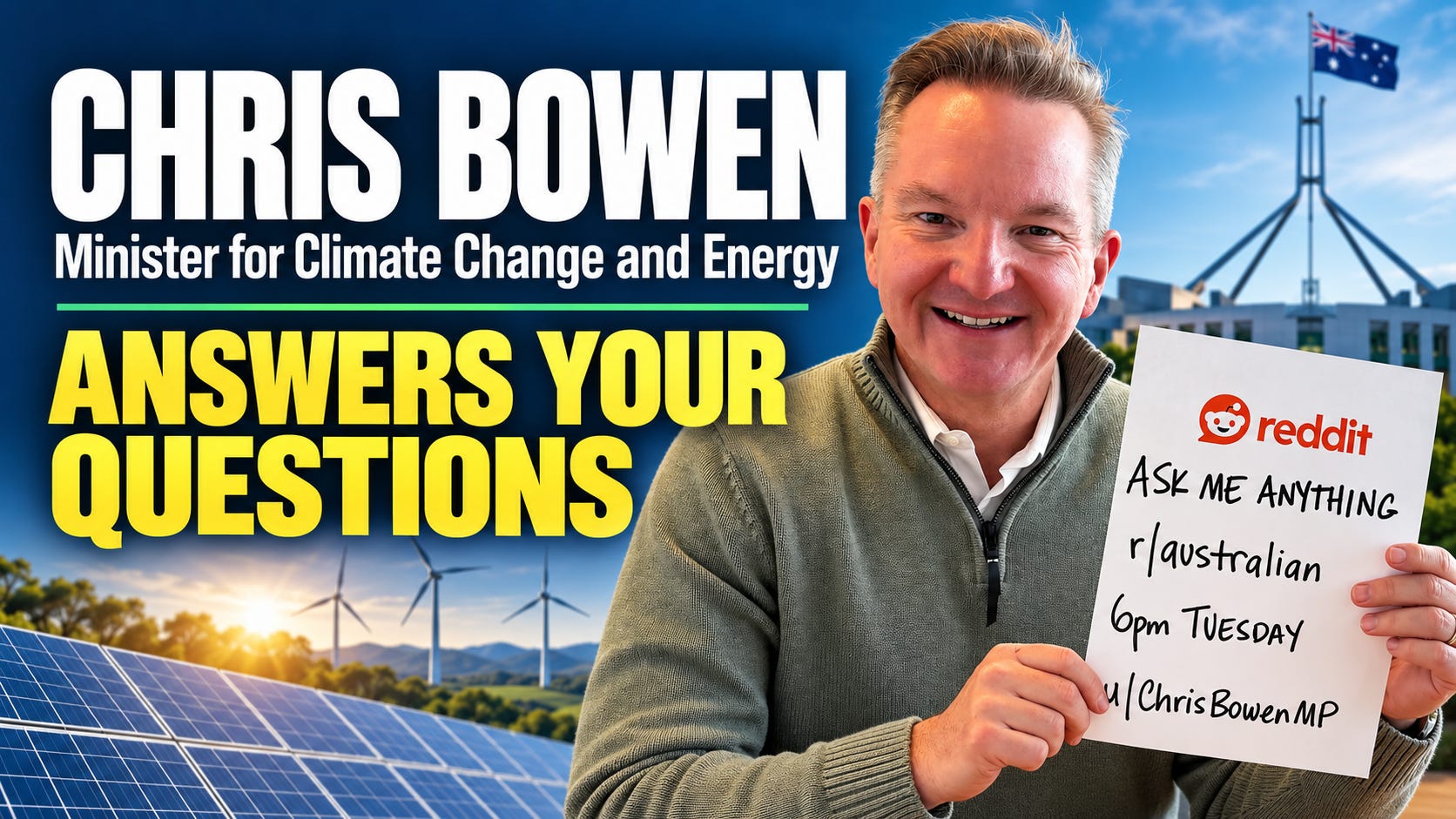
Federal Climate Change and Energy Minister Chris Bowen told an Ask Me Anything session on Reddit’s r/australian forum that falling wholesale electricity prices would take time to reach household bills.
Responding to a reader who asked why higher daily supply charges were swallowing savings on usage rates, Bowen said he had asked the Australian Energy Regulator and the Australian Competition and Consumer Commission to examine how retailers were packaging charges.
He pointed to consumer protections that had taken effect in July and urged households to compare plans through Energy Made Easy, while acknowledging that some customers had limited choice.
Another reader asked whether the government would tie retail electricity prices to wholesale prices and act on rising supply charges. Bowen pointed to reforms already made and said wholesale costs accounted for about 40 per cent of retail prices. He did not say whether the government would adopt a pricing mechanism of the kind the reader proposed.
A third reader cited rising energy debt and enrolments in hardship programs and asked whether the rules allowed retailers to undo the benefit of a lower default market offer. Bowen referred the reader to an earlier answer in the thread.
Home batteries and plug-in solar
Asked to restore the Cheaper Home Batteries subsidy to its 2025 rate, Bowen defended the changes as a way to reach more households. He said the government now expected about two million Australian homes to have a battery by 2030, twice its initial estimate, and that households had continued to install around 2,000 batteries a day after the changes.
One participant offered their own experience with the battery policy, saying their household’s daily electricity costs had fallen from $10 - $15 to about 50 cents. Bowen welcomed the account.
On whether plug-in solar and batteries would be allowed, Bowen said state and territory energy ministers had agreed to start work on rules that could open up the technology to renters and apartment residents. He hoped for progress within months and said safety standards still had to be settled.
Climate targets and resources
Asked how the government reconciled approving fossil fuel projects with the need to cut emissions, Bowen argued that building more renewable generation was the way to reduce fossil fuel use while keeping the grid reliable. He said gas and metallurgical coal were still needed to build renewable energy and transmission infrastructure, including to make steel. He also pointed to Australia’s role leading negotiations at COP31 as a chance to encourage other countries to expand renewables.
A parent who said they had lost faith in the government’s response to climate change asked what they could tell their children about continued dependence on fossil fuels. Bowen said global warming projections had fallen since the Paris Agreement, from about 4 degrees to around 2.6 degrees under current policies.
He acknowledged that the world was expected to overshoot 1.5 degrees and said renewables had reached 50 per cent of the Australian grid, up from 33 per cent when Labor took office.
Asked whether Australia should nationalise its resources to better fund health and education, Bowen said taxpayers would shoulder the high costs and risks of exploration and development. He backed a role for government in critical minerals projects and said private companies should generally develop resources, with the public benefiting through royalties, taxes and jobs.
Data centres
A technology worker asked who was advising the government on AI data centres and how it would stop them from driving up power and water costs. Bowen said projects should proceed only if they served the national interest and said operators should “bring their own new renewable energy” to ease pressure on electricity prices.
He said Murray Watt was working on water issues and that the government was working on legislation. His reply did not identify who was advising the government.
A separate reader asked what regulations were under consideration to manage data centres’ energy and water use. Bowen directed the reader to an earlier reply in the thread.
Electric vehicles and diesel dependence
Asked what help was available for drivers switching from petrol cars to electric vehicles, Bowen pointed to the electric vehicle tax concession and low-interest loans available through the Clean Energy Finance Corporation.
He said new vehicle efficiency standards were encouraging manufacturers to bring more efficient models to Australia and pointed to the growing number of electric vehicles priced below $40,000.
A final transport question asked how Australia could reduce its long-term dependence on diesel. Bowen cited electric vehicle uptake and work to expand the use of biofuels made from Australian agricultural products. He said those fuels could make Australia’s supply more reliable, alongside efforts to secure fuel in the short term.
The questions were sourced from the general public through an online Q&A on the Australian community of Reddit (AMA): https://www.reddit.com/r/australian/comments/1wgob23/ama_im_chris_bowen_minister_for_climate_change/