

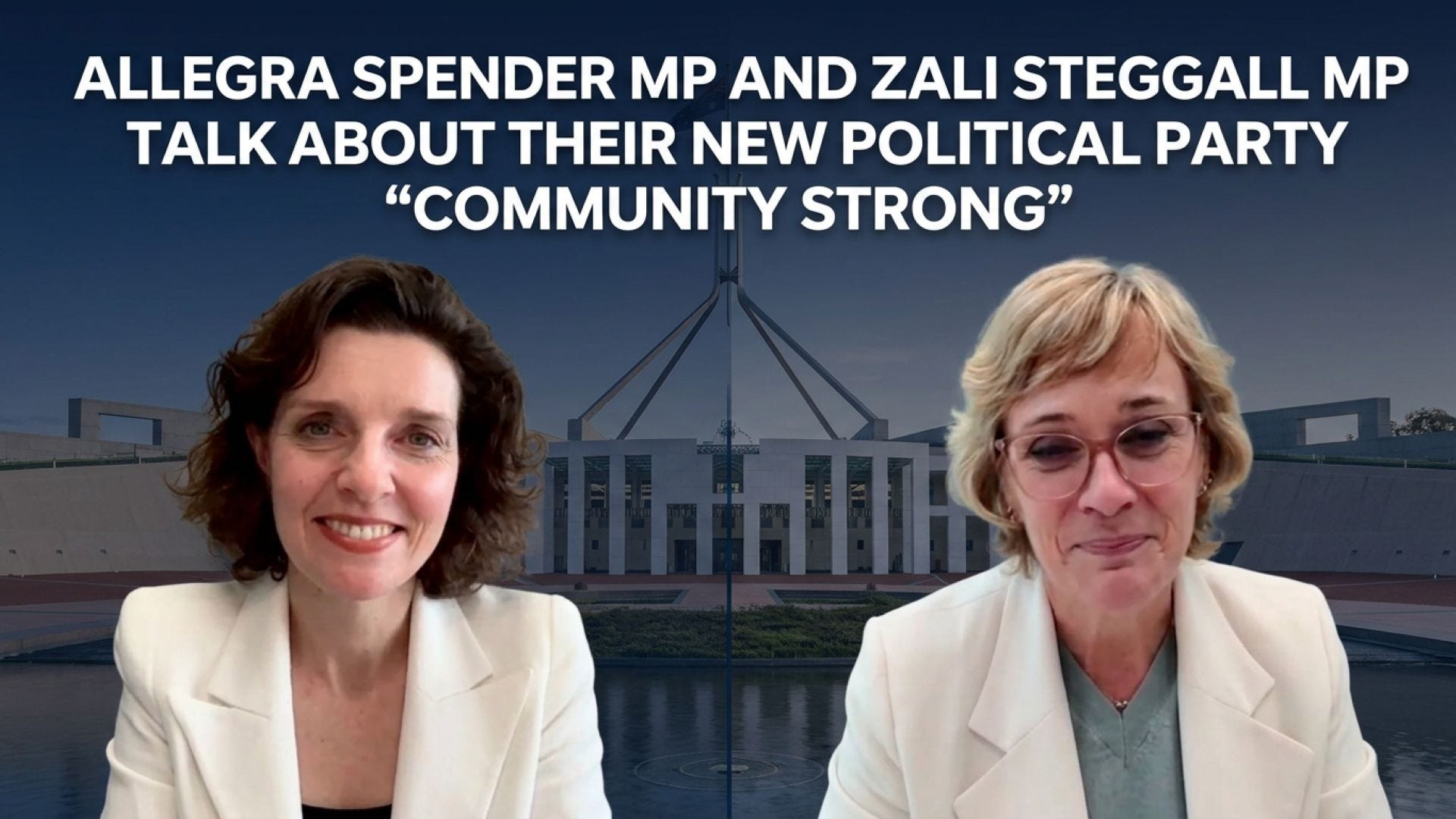
Community Strong Australia is intended to extend community representation into more electorates and the Senate while preserving MPs’ freedom to vote independently, Allegra Spender and Zali Steggall told Pub Politics. Asked why they were forming a party, Steggall said a shared structure offered economies of scale without requiring a binding party line.
MPs would still assess legislation and consult their communities, she said, noting that she and Spender already voted together most of the time because their values aligned. Spender added that the initiative would seek people with substantial experience outside politics, drawing on her own business and not-for-profit background and Steggall’s careers as a barrister and Olympian.
The name was itself a question for readers who wondered why they had not simply adopted the established “teal” label. Steggall described teal as a media-created category rather than the foundation of their project.
Community Strong Australia was meant to give communities a vehicle for participation and representation, she said, and not every MP described as teal was involved. With only herself and Spender under discussion, she joked that they might instead be the A to Z of politics.
Asked which established party they were closest to, Spender declined to nominate a fixed political partner. She said her approach was to assess issues on their merits and work across parliament, combining environmental concern and a compassionate community with a fair economy that encouraged business investment.
Many voters did not fit neatly into a single ideology either, she argued. The aim was to reflect communities’ priorities rather than force every issue into a predetermined party position.
Their representation of comparatively affluent electorates prompted a challenge about appealing to middle-income communities facing overcrowded schools and population growth. Spender said Wentworth’s wealth did not describe every resident, citing the large proportions who rented or lived in apartments.
More broadly, she argued that frustration with major-party representation extended across socioeconomic groups. Steggall added that issues such as integrity and gambling advertising reform attracted support across geographic boundaries. Better representation of communities bearing the pressures of growth, they said, could lead to better planning and decisions.
On gambling, resource taxation, political money and lobbying, Steggall called for stronger transparency and a greater revenue contribution from the resources sector, particularly gas exports. She supported implementing gambling advertising reform recommendations and criticised the influence of major industry lobby groups on government decisions.
Spender pointed to what she described as a recent crossbench success: greater disclosure of which MPs sponsored lobbyists’ parliamentary passes and restrictions on unrestricted access. Both presented greater visibility of political influence as central to changing parliamentary culture.
Migration policy, Spender argued, needed to connect the number and skills of arrivals with housing, roads, hospitals and schools. She wanted greater attention to construction trades and criticised successive governments for failing to plan adequately for population growth.
Steggall warned that an arbitrary headline number overlooked the workers sustaining sectors such as nursing, aged care and construction. Neither nominated a specific intake target. Their emphasis was on better planning, with infrastructure and services arriving before or alongside growth, while recognising migration’s contribution and avoiding divisive blame.
Early childhood education brought agreement on its importance but no detailed replacement funding model. Steggall emphasised its role in children’s development as well as parents’ workforce participation, and raised concerns about how proposed NDIS changes could affect support for young Australians.
Spender said high fees remained a serious burden, particularly for families with two children in care, and could influence decisions about having another child. She acknowledged additional government investment but said the system still was not working as it should and required further attention.
Asked whether a carbon tax or emissions trading scheme remained worth pursuing, Spender said pricing carbon was an economically efficient way to reduce emissions at lower cost. She also supported a carbon border adjustment mechanism to protect Australian industry from more polluting competition and retain relevant revenue in Australia.
Steggall criticised the dismantling of earlier carbon-pricing arrangements under her predecessor, Tony Abbott, and described the current approach as fragmented. The pair wanted to examine how existing mechanisms fitted together and whether they could be simplified into a more coherent trading framework, without promising an immediate return to the former system.
Steggall’s assessment of Labor’s climate agenda was mixed. She welcomed progress on electricity, rooftop solar and household batteries, but argued that climate policy needed to extend further into transport, agriculture, industry and aviation. Continuing coal and gas approvals undermined progress, she said, while insufficient attention to resilience and adaptation left households exposed to rising insurance costs. Spender explicitly endorsed Steggall’s answer, observing that their frequent agreement did not require them both to repeat every response.
Their musical tastes offered a lighter point of comparison. Spender named Powderfinger and Crowded House alongside Dua Lipa, whose music suited her enthusiasm for running, and said her children influenced her listening.
Steggall also linked music with running, choosing G Flip for energy and Angus and Julia Stone for relaxation. Having grown up in France, she recalled INXS and Midnight Oil as formative musical connections with Australia.
Pressed to choose one favourite song, Spender settled on Powderfinger’s My Happiness. Steggall nominated G Flip’s Bed on Fire as a recent favourite, connecting the choice with her enjoyment of the series Off Campus. Both initially found the demand for a single selection harder than naming a range of artists.
A question about favourite films turned into a discussion of television. Steggall chose Ted Lasso, explaining that her background as an Olympic athlete made its treatment of sporting psychology, optimism and problem-solving especially appealing.
Spender selected Colin from Accounts, recalling how much she had enjoyed the Australian comedy. Neither offered a film choice in the exchange.
Asked to name favourite local restaurants, Spender described familiar family outings, including Christo’s Pizza at Five Ways and Love Supreme on Oxford Street, as well as Japanese meals around Rose Bay and Vaucluse.
Steggall joked that choosing favourites risked upsetting other venues, then described a French bistro in North Sydney as a special-occasion destination, particularly for her husband’s favourite steak tartare. Both spoke warmly about the range of hospitality businesses in their communities.
You can see the full interview with Allegra Spender and Zali Steggall on the Pub Politics Video Podcast at:
The questions were sourced from the general public through an online Q&A on the Australian community of Reddit (AMA): https://www.reddit.com/r/australian/comments/1upew09/ama_were_allegra_spender_and_zali_steggall_from/